Skip to content
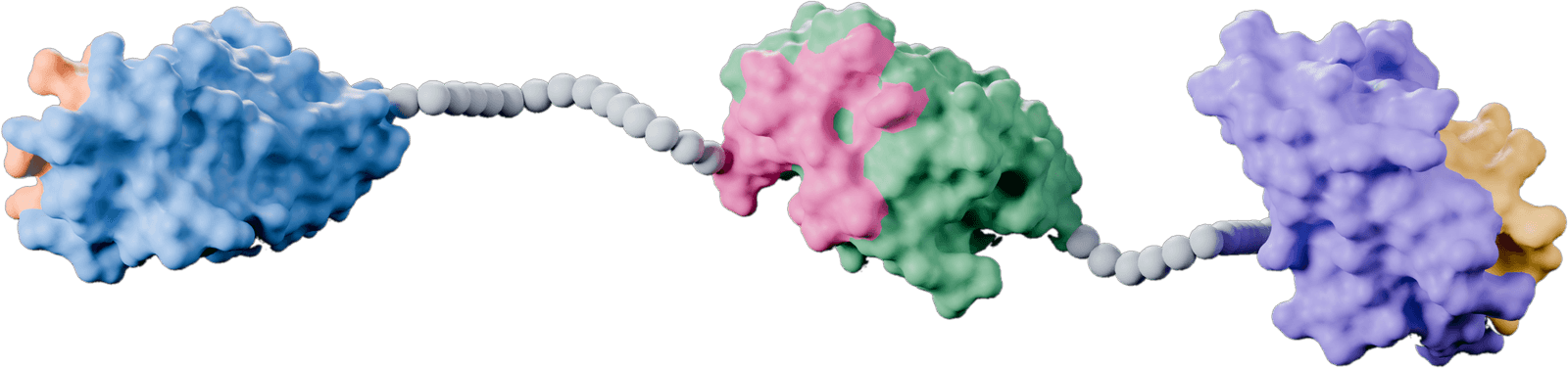
Rendering of a trivalent VHH construct: two target-binding domains and one albumin-binding domain, joined by linkers
A trivalent VHH construct. The format decides what the binder brings with it. Our own rendering.

Oncera develops binders for solid tumours,that are meant to act selectively on the tumour.

Oncera looks for tumour-selective surface targets in tumouroids grown from patient material and designs VHH binders against them with the BEAM AI stack.

VHH, also known as a nanobody: the variable domain of a camelid heavy-chain antibody, about a tenth the size of an antibody.

  • A research project from the Munich life-science ecosystem
  • Research use only, not a commercial service
  • Designed for on-premise installation at a partner site

Where surface programmes die

Three failures compound. Together they stop promising surface programmes between discovery and lead optimisation.

Tumour cell membraneHigh abundance, poor selectivityPrioritised targetLow abundance, missed by screeningGenerated binder
A schematic drawing with no measured data. A conventional screen mostly returns the most abundant proteins on the cell surface. The tumour-selective epitope is often low in abundance and gets missed. The binder is designed against that epitope.

Incomplete target identification

Therapeutically relevant surface epitopes, particularly those at low to medium abundance, stay invisible to classical proteomics and screening pipelines.

AI without a reliable translation step

Older generative approaches are frequently polyreactive, and the sequences they produce enter years-long loops optimising affinity, specificity and developability. Human-relevant validation is rarely brought in early enough to stop that.

High need, few options

Hepatocellular carcinoma and cholangiocarcinoma have poor prognoses and few treatment options. The first bispecific HER2 antibody for pre-treated HER2-positive biliary tumours was approved only in 2024.

A closed design-test-learn loop

Most pipelines run target discovery, binder design and validation as separate workstreams, and only find out at the end whether they agreed. Oncera sets them up as one loop, so that every experiment feeds the next design round. The first round with laboratory data on binders is still ahead.

  1. 01
    Patient-derived tumouroidsA culture dish in section with medium, holding three tumoroids as cell clusters with a lumen, one of them picked out.

    Patient-derived tumouroids

    Feeds the loop

  2. 02
    Surface target prioritisationFive proteins stand in the cell membrane, a lipid bilayer. One carries a marked epitope and is circled, the prioritised target.

    Surface target prioritisation

    Feeds the loop

  3. 03
    BEAM binder generationThree binder designs above a target protein in the membrane, one sits on the epitope.

    BEAM binder generation

  4. 04
    Binding assaysA binding curve on two axes: association, plateau, dissociation.

    Binding assays

  5. 05
    Validation in tumouroidsTwo dishes side by side. On the left a tumoroid with binders docked on its cells. On the right a healthy reference organoid with the binders left free above it.

    Validation in tumouroids

  6. Each round is meant to improve the next design

  1. 01

    Patient-derived tumouroids

    Feeds the loop

    MicroOrganoPits grow tumour avatars from patient material and hold the transcriptional fidelity that 2D cell lines lose.

  2. 02

    Surface target prioritisation

    Feeds the loop

    Tumouroid proteomes and transcriptomes are read against hepatocyte reference organoids and public tumour-normal datasets, surfacing epitopes that abundance-driven screens miss.

  3. 03

    BEAM binder generation

    The BEAM stack generates candidate binders against the prioritised epitopes and scores them for affinity, off-target risk and developability before anything reaches a bench.

  4. 04

    Binding assays

    The most promising designs are to be synthesised and measured against the target protein by SPR and BLI. Affinity and kinetics are to decide which candidate goes into a cell system.

  5. 05

    Validation in tumouroids

    Candidates are to be tested against the same patient-derived systems they were designed for, and against healthy comparators. The comparison is meant to show whether a candidate is selective.

Tumouroids and prioritisation run once per patient line, and the loop is meant to run as often after that as it takes. The tumouroid lines are the basis it runs on: they supply the surface proteome that prioritisation reads, and they are the system a candidate is to be tested in.

Five stations of the loop. Drawings, not measured data.

Co-development with partners, and our own programmes

The two arms are linked: our own programmes are meant to test the platform prospectively and to produce the starting points that co-development partnerships build on.

Co-development

A pharma or biotech partner brings an oncology target question that has been hard to answer. By target, Oncera means the docking site: the surface protein through which a binder reaches the tumour cell. It does not mean the mechanism of action. Oncera delivers prioritised surface targets, binder candidates and validation data from patient-derived tumouroids.

Status: the offer is being built. Validation data from tumouroids is still to come.

How a co-development project runs

Our own programmes

A small, deliberately focused pipeline in three gastrointestinal tumours: hepatocellular carcinoma, cholangiocarcinoma and pancreatic cancer. Each programme tests the platform on a different question of selectivity and format.

Status: preclinical. Laboratory data on the binders is still to come.

The three programmes

The platform carries more than one modality

Oncera develops VHH binders and antibody formats for solid tumours. The binder can be the drug itself or take a payload to the tumour cell, such as a small-molecule drug, an oligonucleotide or a radionuclide.

Rendering of a trivalent VHH construct: two target-binding domains and one albumin-binding domain, joined by linkers
A trivalent VHH construct. The format decides what the binder brings with it. Our own rendering. Two target-binding domains and one albumin-binding domain, joined by linkers. The albumin-binding domain prolongs the residence time in the blood.
  • Antibody-drug conjugate (ADC)

  • Antibody-oligonucleotide conjugate (AOC)

  • Antibody-radionuclide conjugate (ARC)

For ADCs, the next project phase already tests internalisation, trafficking and in vitro toxicity (WP5.3). AOC and ARC are options for the future. Each payload has to be tested separately.

What we measure

Benchmark and laboratory figures go on this page once they have been re-run and cleared. Until then, this is what is measured, and against which baseline.

  • Sequence recovery of the BEAM model

    against ProteinMPNN and AbMPNN on the same test set

  • CDR-H3 retrieval rate

    against the published baseline for the same task

  • Tumouroid take rate for HCC and CCC

    against conventional organoid culture

One piece of evidence is still open: that generated binders bind on patient-derived tumouroids and distinguish them from healthy comparators. The next project phase is meant to deliver it.

Built to run where the data is

BEAM runs on a local GPU workstation and is not run as a network service. For a co-development project it is meant to be installed at the partner, so that sequences and structures stay on the partner's premises. The page on security and compliance lists the other tools Oncera uses and where they run.

Security and compliance

Network and traction

The team’s research institutions, our base at BioM, the programmes that admitted Oncera, and what the project has reached so far, with dates.

Traction

  1. 2024

    DATIpilot

    Funding from the federal DATIpilot programme. The tumouroid biobank grew with it.

  2. 2025

    Nucleate

    Winner of the Nucleate pitch competition.

  3. 2025

    BioLabs

    A BioLabs Golden Ticket: an incubation place and the network.

  4. 2026

    AI NATION MUNICH

    Admitted to the AI NATION MUNICH programme, co-financed by the European Union.

Talk to us about a co-development project

The best fit is a surface target that abundance-driven screening keeps missing, early enough in a programme to still de-risk it.